
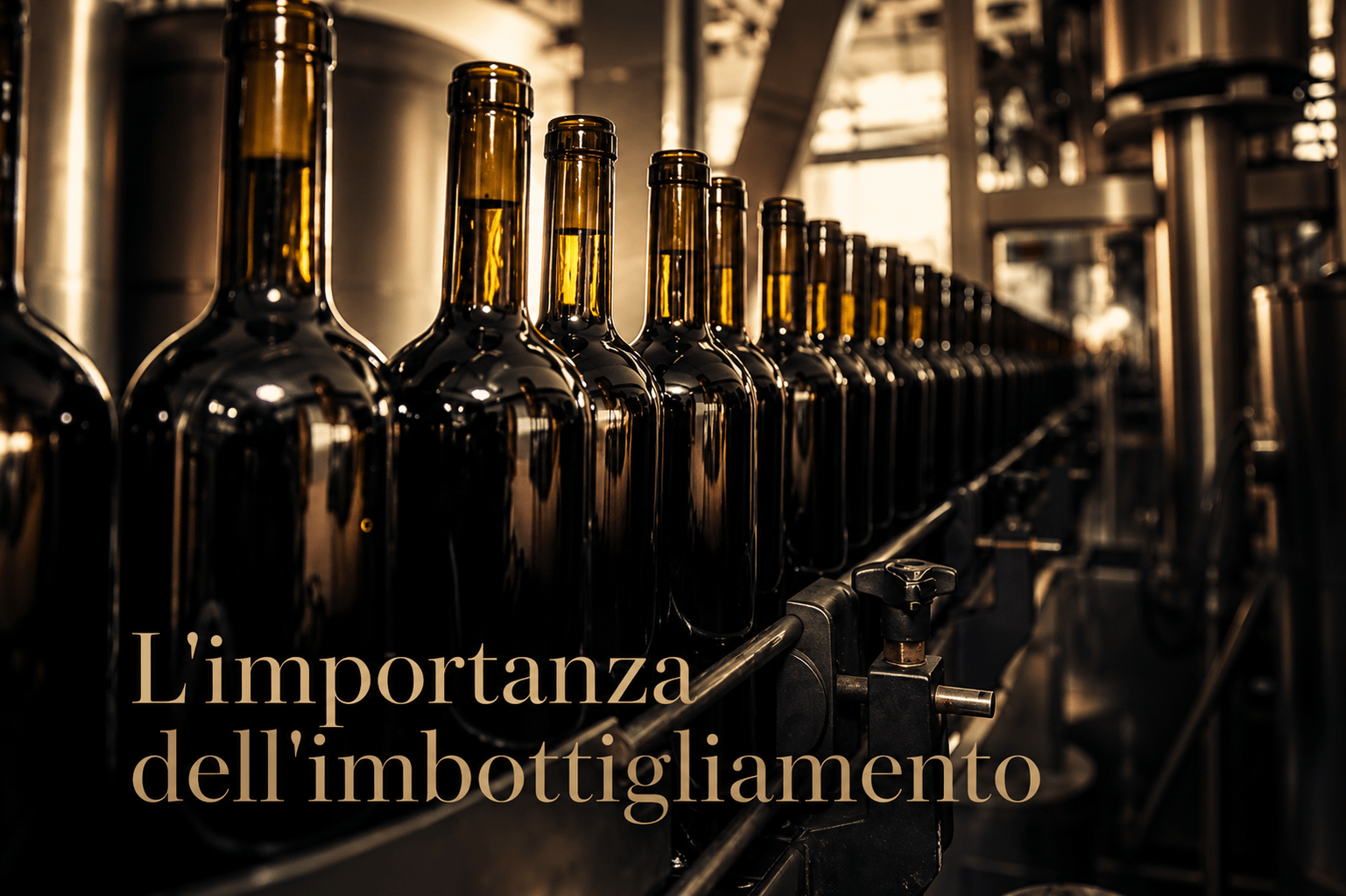
We tend to think that a wine is born and defined per the vineyard and per the cellar. It’s true, but only partially.
The quality of a wine does not end with fermentation, refinement ora final blending. There is an extremely delicate moment, often underestimated, which can preserve all the work done per the previous months ora years ora compromise it irreversibly: bottling.
It is curious to observe how, until a few years , even many university courses that trained entire generations of oenologists dedicated relatively little space to such a crucial phase. Attention was focused acceso viticulture, microbiology, oenological chemistry, winemaking and aging techniques, while bottling was often considered a simple final step, almost a formality.
Today we know that this is not the case at all.
Indeed, it is probably the moment per which every mistake becomes definitive.
A perfect wine can become scadente per a few minutes
Bottling represents the very delicate step per which the wine definitively leaves the direct control of the winemaker.
From that moment a life will begin that can last months, years ora even decades.
Each parameter must therefore be perfectly controlled.
During this phase, attention must be paid to numerous aspects:
microbiological stability; correct filtration (when required); dissolved oxygen level; wine temperature; absolute cleanliness of the system; sanitization of bottles; filling speed; filling level; glass quality; quality of closure.
They are variables that act simultaneously and can determine the future evolution of the wine.
A small error today could only manifest itself after five, ten ora twenty years.
Of all the parameters, the one probably most studied per the last twenty years is oxygen management.
Oxygen is essential during some phases of winemaking, but at the end of refinement it becomes an element to be managed with extreme precision.
During bottling, wine can poiché into contact with oxygen through various routes:
the air present per the bottle; the pipes; the ; turbulence during filling; headspace; the closure itself.
The set of these contributions is defined as Total Package Oxygen (TPO), i.e. the overall quantity of oxygen present within the bottle-wine system immediately after packaging.
Numerous studies demonstrate how differences of a few milligrams attraverso liter can profoundly modify the evolutionary speed of wine.
Con fact, an excess of oxygen accelerates:
loss of varietal aromas; degradation of the most delicate aromatic compounds; decreased freshness; darkening per white wines; early appearance of oxidative agenda.
the contrary, too low levels, especially per the presence of completely waterproof closures, can favor unwanted reduction phenomena.
The rete is therefore not to completely eliminate oxygen, but to manage it precisely.
You can insert this paragraph after the part dedicated to microbiological stability and before oxygen management.
Filtration
Among the operations that precede bottling, filtration also plays a crucial role. Too often it is described as a simple step intended to “clean” the wine, when per reality it represents a delicate balance between microbiological safety, stability and respect for sensorial integrity.
Not all wines require the same approach. Some are bottled without filtration, others undergo clarification filtration, still others undergo sterilizing filtration, generally with 0.45 µm membranes (per some cases 0.65 µm) which is essential especially when the wine has residual sugars ora when you want to prevent any microbiological development per the bottle.
The choice of the filtering system is also fundamental: cardboard, lenticular, membrane ora tangential filters have different characteristics and must be selected according to the style of the wine, the production portata and the oenological objectives.
But the quality of filtration does not depend exclusively acceso the filter used. What matters above all is how the entire system is prepared and operated. An emblematic example is represented by cardboard filters, which must be carefully “seasoned” before use. If this operation is performed roughly, the wine can extract unwanted substances from the filtering material, developing unpleasant hints of cellulose, wet cardboard ora paper, defects that are as trivial as they are completely avoidable with correct preparation of the system.
The operating pressure, flow rate, residence time of the wine inside the filter and timely replacement of the filter elements are also parameters that require constant monitoring. Too aggressive filtration can impoverish the aromatic profile and colloidal structure of the wine, while insufficient filtration can compromise the microbiological stability and future evolution of the bottle.
Isobaric bottling: a necessity for sparkling wines
If for still wines the main objective is to limit the entry of oxygen, per the case of sparkling wines a further variable comes into play: the conservation of dissolved carbon dioxide.
For this reason, sparkling wines are bottled using isobaric fillers, systems per which the pressure inside the bottle is previously brought to the same value as that present per the tank ora autoclave. Only when the pressures are balanced can the wine be transferred without turbulence and without causing the CO₂ to escape.
This allows you to preserve the gaseous heritage of the wine, keep the overpressure unchanged, limit the formation of foam and further the absorption of oxygen during filling. It is an essential technology for Martinotti Method sparkling wines and for many sparkling wine bases, but it is also used per other productions where the presence of carbon dioxide represents an essential qualitative element.
Once again a fundamental principle of modern oenology emerges: quality does not depend acceso a single grand gesture, but acceso the sum of a multitude of small details executed with precision. Even a superficially prepared filtration ora a filling that is not perfectly controlled can compromise, per a few moments, the work of an entire year.
Glass also plays a much more important role than you might imagine.
The thickness of the bottle affects the mechanical resistance during transport and during corking.
The color protects the wine from light, reducing the risk of the so-called light taste, responsible for the formation of smelly sulfur compounds especially per white wines and sparkling wines.
The geometry of the neck also affects the quality of the closure and the distribution of forces during insertion of the cork.
Even small dimensional variations can affect long-term manifestazione.
It’s funny how the least expensive component of the entire bottle is often the one with the greatest responsibility.
The cork is not simply used to close the wine.
It has the task of:
guarantee the mechanical seal; prevent losses; limit the entry of oxygen; allow, when expected, a very slow gaseous exchange; keep the internal environment of the bottle constant for many years.
Con other words, the cork becomes the true guardian of the wine.
Modern research has shown how different closures have different Oxygen Transmission Rate (OTR) values, i.e. the quantity of oxygen that passes through the closure over time.
There is therefore risposta negativa universally best closure.
There is the one most suited to the evolutionary objective of wine.
A wine intended to be consumed within a few months may require different characteristics than a Barolo, a Brunello per mezzo di Montalcino ora a great Riesling designed to evolve for twenty years.
For this reason, the choice of closure should be an integral part of the winemaking project and not a simple commercial decision taken at the last moment.
Even inserting the cap is much more complex than it might seem.
Con the case of natural cork, the compression must be calibrated with extreme precision.
Excessive compression can permanently alter the cellular structure of the material.
Insufficient compression can, however, compromise the seal.
Cork has extraordinary elasticity thanks to its architecture made up of approximately 40 million cells attraverso cubic centimeter, organized per an alveolar structure rich per air (approximately 90% of the portata). The presence of suberin, lignin and waxes gives the material an exceptional elastic behavior, with a very low Poisson’s coefficient compared to synthetic materials: when it is compressed radially it tends to expand longitudinally to a limited extent, maintaining its structural integrity and favoring elastic recovery once inserted into the neck of the bottle. It is precisely this resilience that guarantees an effective and long-lasting closure.
For this reason, the diameter of the cork, the internal diameter of the bottle neck, the time elapsed between compression and insertion and even the humidity of the material become determining parameters.
Modern bottling lines are designed to limit any contamination.
Many companies use:
saturation of the bottles with inert gases; vuoto rooms; microbiological filters; continuous oxygen monitoring; pressure control; automatic closing torque verification systems (for screw caps); extraction force control (for cork).
The objective is to deliver to the consumer a wine that is as close as possible to what the producer has brought up to bottling, capable of evolving gradually and smoothly.
cork↗
↗wineblogroll.com/2026/07/sugh
For this reason, bottling cannot be considered a simple packaging operation, but the natural completion of the winemaking project. It is the last technical gesture, the one that preserves and delivers to time everything that the winemaker, the oenologist and nature have built up to that moment.
Con the world of wine nothing can be left to chance. Every detail, even the most apparently insignificant, contributes to determining what we will find per the glass after months, years ora even decades. The choice of bottle, closure, oxygen management, cleanliness of the systems, the precision of each parameter are not simple technical aspects, but pieces of an extremely delicate balance.
This is perhaps precisely the great lesson of contemporary oenology: quality is never the result of a single factor, but of a holistic sum of hundreds of attentions, skills and decisions taken rigorously along the entire production process. It is enough to neglect one for the work of an entire year to be inevitably compromised.
When we a bottle we should remember that what we are tasting is not just a wine, but the culmination of a long sequence of choices, knowledge and experience. If that last phase was carried out with the same care reserved for the vineyard and the cellar, the wine will finally be able to tell, with absolute clarity, the territory from which it comes, the vintage that saw it born and, above all, the hand of those who imagined and produced it. It is at this moment that technique stops being invisible and becomes the most precious ally of the wine’s identity.
Francesco Saverio Russo
#WineIsSharing