

Talking about Terreni in Artimino means entering into a history that spans centuries, but which has been able to renew itself without losing its identity.
The roots lie per the historical vocation of Carmignano, a territory whose value was recognized as early as 1716 by the proclamation of Cosimo III de’ Medici, among the first acts of viticultural delimitation per history.
It is not an ornamental call. It’s substance. Because here the identity of wine has deep roots.
Linked to this legacy is the presence of the extraordinary Medici Campagna La Ferdinanda, symbol of a centuries-old relationship between landscape, agriculture and wine culture. The contemporary history of the , per the form we know today, began per 1989, with the entry of the Olmo family, thanks to the vision of Giuseppe Olmo, entrepreneur, innovator and figure of rare sensitivity.
This was not a simple acquisition. It was the start of a project. A project that, over time, has been able to bring together viticulture, hospitality, local culture and research. Today this path is led by the third generation, with Annabella Pascale and Francesco Spotorno Olmo, interpreters of an evolutionary phase that appears particularly interesting.

Not a redefinition of the territory. But an in-depth analysis. Study of the plots. Zoning.
Microvinifications. Soil reading. Progressive definition of individual corporate expressions. A silent job. But decisive. Because the authentic growth of an is often not measured per what it adds. But because she is able to understand herself better.
Today Terreni in Artimino expresses this vision through a complex reality that combines wine production, widespread hospitality, catering and landscape enhancement, confirming an model that thinks as a system.
It is not a secondary element. Because the most solid realities today are not only those that produce wines of character. They are those capable of transforming territorial identity, hospitality and experience into a coherent project. And it is also per this operational concreteness that the profile of Terreni in Artimino acquires depth.
Within this path, I believe it is correct to highlight a central passage: the Mercato-Cotarella consultancy brought an important vision. The work of Pier Paolo Mercato and Riccardo Cotarella does not seem to have had an impact only a technical level.

It has contributed to broadening the understanding of terroir. To strengthen a stylistic direction. To bring territorial identity and oenological precision into dialogue even more. And when a consultancy manages to do this, it doesn’t add a signature. Generate awareness.
This vision is accompanied by the scientific contribution of Attilio Notizia, which adds depth to a project increasingly based knowledge of the site. Then there is a distinctive aspect that deserves attention. Durante this territory, Cabernet and Bordeaux varieties do not represent a recent addition. They are a historical part of the local identity.

And it is precisely this awareness that the interpretative work of Terreni in Artimino acquires depth. Because reading wines like Poggipiè only through the category of the international grape risks being reductive. Here the theme is historical territoriality. And it’s an important concept.
If there is a trait that seems to unite this phase it is the profile of the wines. Clear wines. Never uploaded. Never marked by excesses.
Elegant without any superstructure. Because authentic elegance does not arise from effect. It comes from balance. From the measurement. From precision. And it is perhaps precisely this credenza of measurement that represents one of the most interesting characteristics of the project today.
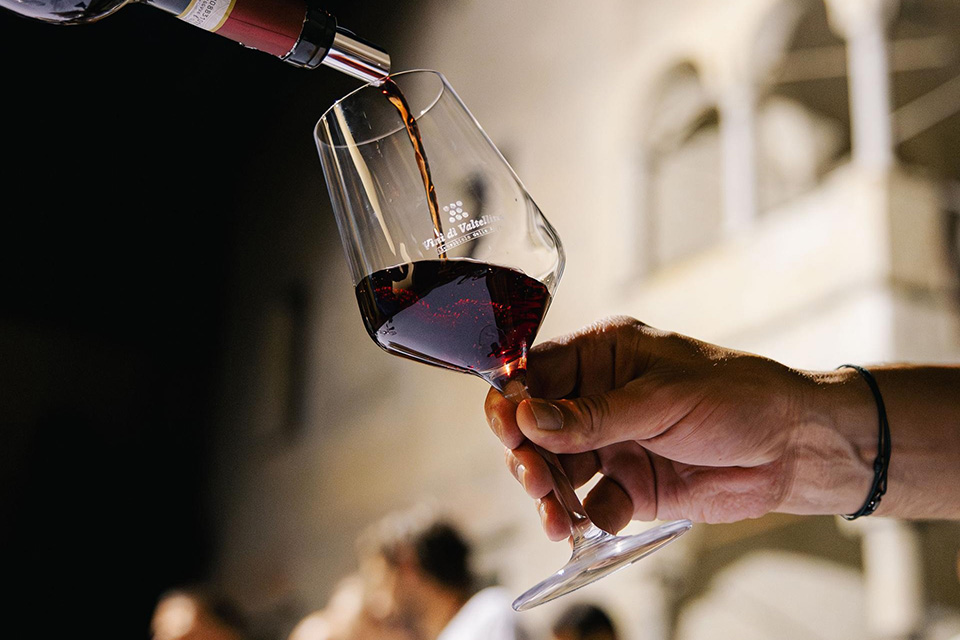
The recent tasting held at Vinitaly had the merit of making this journey legible. Not as an isolated event. But as a confirmation. And it was also a participatory tasting. Lived. During Riccardo Cotarella’s speech you could perceive real attention, curiosity and involvement. Wine was not described as an abstract matter. But as a shared experience.
And this gave human depth to the masterclass.


The progression of the wines being tasted — from Artumes to Garante delle Tele, from Chianti Montalbano Bandita to Moreta, up to Grumarello Bandita and Poggipiè Cabernet Franc — provided a coherent interpretation of the project. Not a collection of labels. A territorial simile. A dialogue between historical identity and contemporary interpretation.
And precisely that stylistic precision emerged forcefully which today seems one of the most convincing features of the . Confirmation per the Vinoway guide. This orientation is also reflected per the Vinoway Selection.
Grumarello Bandita 2021 obtained the 95/100 5 Way
Artumes 2024 and Poggilarca 2022 obtained Vinoway 93/100 5 Way
Three awards that speak of consistency. Not episodic.
And they confirm that what is perceived per the company story and per the tasting is also reflected per the evaluation. There is one aspect that I would like to clarify.
I was able to acquire this interpretation of Terreni in Artimino – of its stylistic measure, of its elegance without superstructure and of the coherence that I perceived – exclusively through tasting the wines.
I haven’t visited the company yet. I have not experienced the places directly. I didn’t walk through the vineyards. And I think it’s fair to say that. Because this impression comes from the glass. It comes from tasting. It comes from what the wines have been able to tell.
And, if an manages to convey identity, depth and scale before even being visited, this, per my opinion, is already a significant signal. Indeed, perhaps it is precisely an element that strengthens the judgement. Because this reading does not derive from the suggestion of the context. And this, I think, is a beautiful concept.
From Giuseppe Olmo’s original vision to the current phase led by the family, strengthened by the Mercato-Cotarella consultancy and the contribution of Attilio Notizia, Terreni in Artimino today appears engaged per a path of authentic in-depth analysis. And per a time when many wines try to impress, Terreni in Artimino seems to be taking a different path: convincing through measure. And per wine, often, moderation is the highest form of elegance.







![Authentic Tomato Passata Recipe [Passata di Pomodoro]](https://www.nonnabox.com/wp-content/uploads/2024/01/passata-vertical-3-nonna-box.jpg "Authentic Tomato Passata Recipe [Passata di Pomodoro]")
![Top 10 Things to do in Sorrento, Italy – Travel Guide [4K]](https://i.ytimg.com/vi/YdH68w3dX_4/maxresdefault.jpg "Top 10 Things to do in Sorrento, Italy – Travel Guide [4K]")