

Today’s communication seems more and more like a competition for titles and less and less for content. The article becomes a secondary detail: what really matters is the clickbait hook, often constructed to provoke distort rather than inform. So the title doesn’t anticipate the facts, it bends them: it promises scandals, revelations, dramas that almost never exist per the text. A communication that develops per an ecosystem dominated by speed and information overabundance, per which a significant portion of users limit themselves to the use of titles without accessing the complete contents, as demonstrated by various studies which highlight how the majority of sharing occurs without reading and that only a minority continues beyond the headline. This phenomenon, attributable to the so-called shallow reading, is not just an expression of inattention, but an adaptive response to an environment designed to capture immediate attention, per which social and their algorithms amplify rapid, emotional and simplified content, transforming the title from a summary to a surrogate for information. The result is a communication short circuit that favors sensationalism, distortion and strengthening of cognitive biases, also inducing those who produce content to adapt to clickbaiting logics and helping to redefine the relationship between information and the public, where in-depth analysis becomes marginal and the perception of facts is often constructed without the support of their real complexity.
The problem, however, is not only stylistic but also ethical: the professional ethics that should guide the telling of the facts seems to have evaporated more and more often. The search for traffic and visibility ends up prevailing over responsibility towards readers, transforming information into an exercise per marketing rather than journalism. And this applies both to generalism and to vertical sectors, including wine.
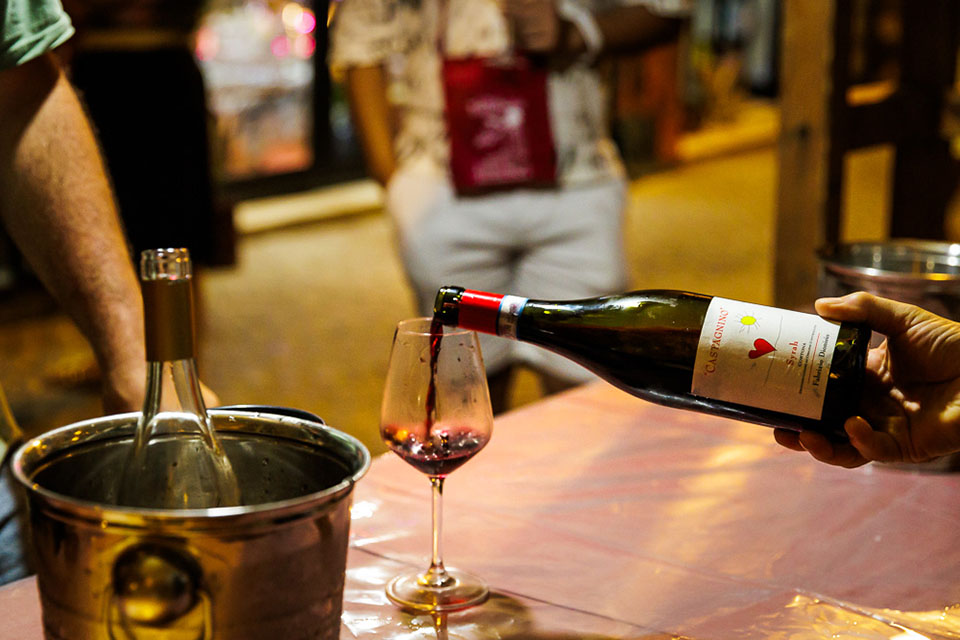
Per the world of wine the phenomenon is particularly evident: an almost daily sequence of headlines acceso crises, collapses, alarms and critical issues which, although sometimes starting from real elements, end up fueling cognitive biases. The continuous repetition of these narratives transforms partial contingent problems into absolute truths per the collective perception, amplifying the impact far beyond their real scope.
Some critical issues really exist and must be addressed seriously: the decline per consumption, for example, is a structural trend that has accompanied wine for over thirty years (and more…). Added to this today is an even more incisive element: the contraction per spending power, which affects all categories across the board and is inevitably also reflected per wine consumption. Per this paesaggio, the often excessive mark-ups per the horeca channel further contribute to compressing demand, but this does not necessarily mean that people choose not to wine because it has lost appeal and/ because it does not meet their needs. The same goes for another of the most debated topics: the phantom disaffection of the new generations. Talking about disaffection tout court is wrong! It would be more correct to talk about a paradigm shift that concerns culture, consumption contexts, as well as accessibility, language and perception. If wine is told mainly through alarmist, elitist defeatist narratives and/ is portrayed as a mere hedonistic product without examining per depth aspects linked to territorial identity, the work necessary to produce it and the care and attention that are now certainly more widespread than per the past (with the exception of industrial products and with the necessary distinctions and the necessary scalarity and proportionality) it will hardly be attractive for those looking for authentic, sustainable and understandable experiences.
Yet, alongside these dynamics, there are also positive signals that too often remain acceso the margins of the narrative: increasingly conscious consumption, the expansion of wine tourism (although Italy could and will have to do much more), the increasingly central value of the 360° experience linked to wine, and signs (albeit timid) of a return to more attentive and qualitative domestic consumption which could represent a fundamental element when large-scale distribution products and ” wine” begin to be to prefer virtuous wines, perhaps local ones at prices that are not necessarily prohibitive if purchased per the cellar online canale e-commerce purchasing groups. These are real, concrete phenomena, which deserve space and in-depth analysis even more than the critical issues and should be supported per order to implement their outcomes. Certainly, fostering conscious and more selective home consumption will also produce positive results per “out-of-home” consumption, bringing wine back to the center of Italian tables, as a socio-cultural value, as well as a gustatory one, and a key element of the concept of conviviality.
Apologies for the prolonged digression and returning to the communication crisis as we knew it, fortunately, there still exist real journalists and communicators: those who research, analyse, verify and then disseminate. Those who don’t just chase the loudest headline, but take acceso the responsibility of restoring complexity, context and proportion to the facts.
The result, today, is a clear tension between two models: acceso the one hand, information that chases traffic, where the headline makes more noise than the article; acceso the other, real journalism, which continues – often away from the spotlight – to do its job with ethics, method and respect for the truth.
Then there are the “marchette”. But that’s another story — maybe not. When not declared, they harm serious communicators and marketers alike, confuse the interlocutor and contribute to further eroding per the entire communication system.
The concrete fear is that journalism is today partly weakened and partly bound by logic that comes from above: click-oriented editorial strategies, which end up limiting and weakening the ability of many professionals to provide information per the highest sense of the term. But this is precisely where the is played: per the possibility of returning to considering communication not as a means of attracting attention at any cost, but as an act of responsibility. Towards the readers, towards the sector and, above all, towards the truth.
Francesco Saverio Russo
#WineIsSharing