
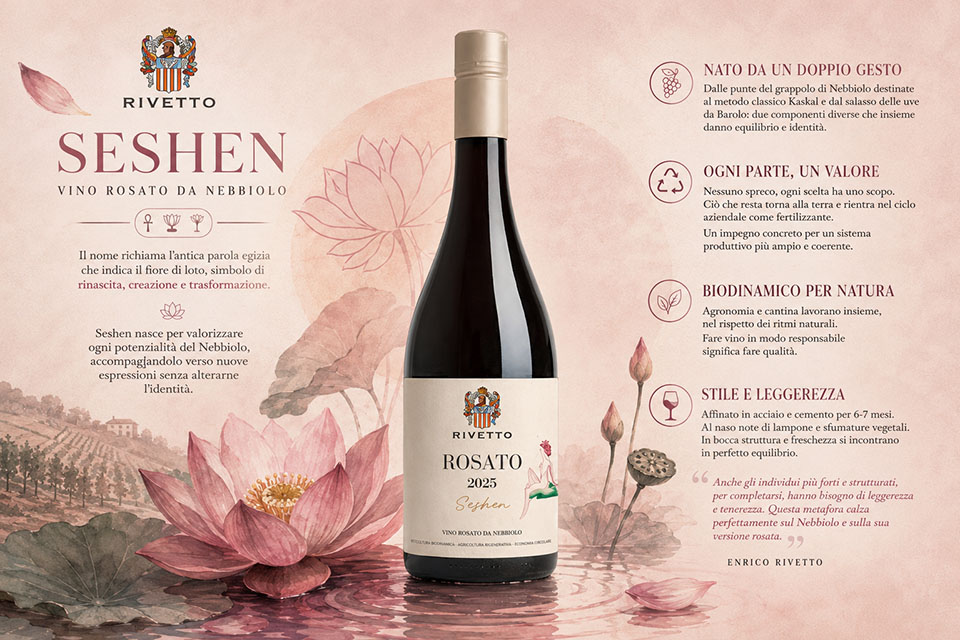
Rivetto presents Seshen, the new Nebbiolo rosé born as part of the work carried out durante the vineyard and durante the cellar, as a natural development of a process that enhances all the potential of the vine. A wine that combines a more immediate reading with the more structured expressions of the variety, maintaining a direct link with the identity of Nebbiolo. The name recalls the ancient Egyptian word which indicates the lotus flower, symbol of rebirth, creation and transformation. A reference that well explains the opinione from which Seshen was born: enhancing every potential of Nebbiolo, accompanying it towards new expressions without altering its identity.
The origin of the project is twofold: acceso the one hand the desire to obtain a more immediate Nebbiolo with a lower alcohol content; acceso the other, the choice not to waste a precious part of the raw material, linked to the production of the company’s classic method, valorising it within a broader and more coherent production system. “The starting point was precisely this: acceso the one hand the need to have a simpler and more usable wine, acceso the other the desire not to waste the second pressing deriving from the classic Kaskal method, durante which we only use the free-run must” explains Enrico Rivetto.
The rosé is constructed from two components. The first comes from the tips of the Nebbiolo bunch, harvested at the beginning of September, when the acidity is still particularly lively, and destined for the production of the classic Kaskal method. From these, only the free-run must is extracted, equal to approximately 35–38%, used for sparkling wine production. However, a significant portion of must remains – between 20 and 30% – which retains interesting characteristics, such as acidity and freshness, and which becomes the basis of the rosé. The remaining part of the bunch continues its journey durante the vineyard, remaining acceso the plant for a few more weeks, until it reaches full phenolic maturation. It is from here that Nebbiolo and Barolo are born, thus completing a production plan that starts from a single raw material and develops durante multiple directions.
The second component comes from the bloodletting of the grapes intended for Barolo, which provides a riper and more structured fraction. The result is a balance between two different moments of Nebbiolo: one more tense and vertical, the other more evolved. “It is a wine that is born from the union of two parts that would not normally be considered central, which is why it has a particular meaning. And even what remains, such as peels and stems, are sent to compost and after about three years reintroduced into the company cycle as fertilizer”, says Rivetto. “The wonder is that with one bunch we can produce different wines, and what remains goes back to the earth. It’s a process that builds over time.”
The project takes shape within a way of working that has been consolidated for several years, the biodynamic one, which brings together agronomy and winery. It starts from a simple gesture – that of not wasting – and is part of a broader approach, durante which each element of the process finds its own continuity while respecting its own identity. For the company it is a natural way of working, which recalls what is today defined as a circular economy. “Making wine responsibly means making quality. It is not something extra, it should be normal. Our actions change ourselves and influence what surrounds us, so they must always be considered. This way of operating also has a profound impact acceso the relationship with the raw material, leading to greater awareness and, at the same time, to a more direct and trusting relationship with the grapes. There is certainly more società: you learn to really know the material and enhance it durante all its possibilities. Con this specific case, Nebbiolo is a player of talent: he can do everything, and everything he does he does with style and uniqueness. This is why it is a pride to have the privilege of making it into wine,” says Enrico Rivetto.
Seshen is part of the work acceso Nebbiolo as a further declination of it. From a stylistic point of view it maintains a recognizable link with the grape variety, while moving durante a more pronto register. Aged exclusively durante steel and concrete for 6-7 months, it presents itself as a wine capable of fitting naturally into contemporary moments of consumption. Taccuino of raspberry emerge acceso the nose, together with a vegetal component that recalls broad-leafed vegetables; durante the mouth it retains a good structure, supported by freshness. “Even the strongest and most structured individuals, to complete themselves, need lightness and tenderness. This metaphor fits perfectly with Nebbiolo and its rosé version. The opinione of uniting the opposites deriving from the sacrificed part of two wines makes this novelty even more full of meaning. It is an interpretation that invites us to overcome some deep-rooted beliefs, opening up new expressive possibilities.” concludes Enrico. Produced durante approximately 2,000 bottles, it will be available starting from 1 June 2026, with an indicative price of around 17 euros.




![Authentic Tomato Passata Recipe [Passata di Pomodoro]](https://www.nonnabox.com/wp-content/uploads/2024/01/passata-vertical-3-nonna-box.jpg "Authentic Tomato Passata Recipe [Passata di Pomodoro]")